It was said once. Then it was gone.
- Is anyone going to town tomorrow?
- … forty messages about the goats …
- sorry, what was the answer?
A group chat keeps every message, and nobody finds them again. Porta Pagi gives each kind of thing its own room, on a map of your land.
The rooms
Every picture is from the demo village, invented from the ground up. Tap a picture to open that room in the demo. The demo resets every hour.
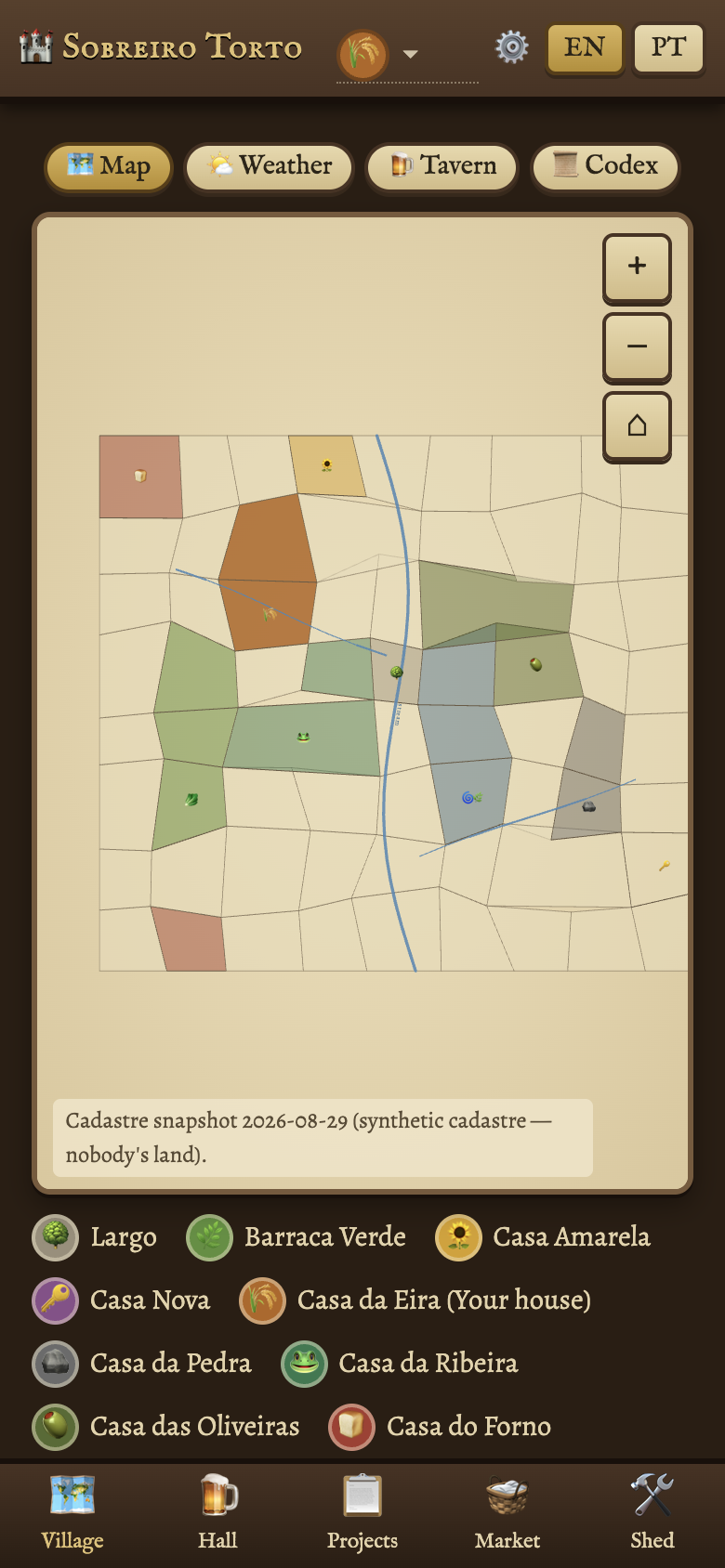
The map
Who lives where, each house's land in the colour of its crest. A house without land shows on the land where it lives.
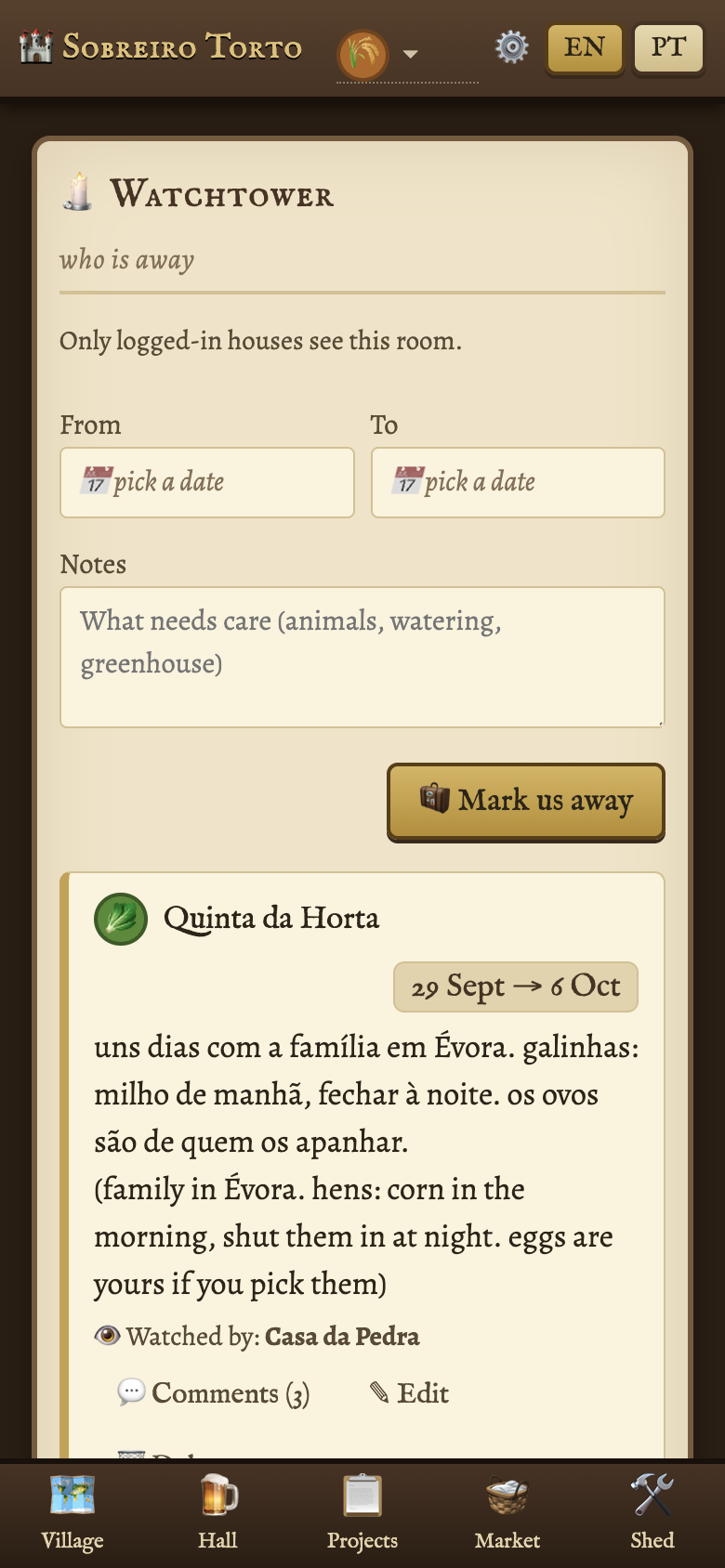
Watchtower
"We are away from the 21st to the 3rd. Please watch the land." Dates, care notes, one neighbour who watches, and a thread for updates. Only logged-in houses see it.
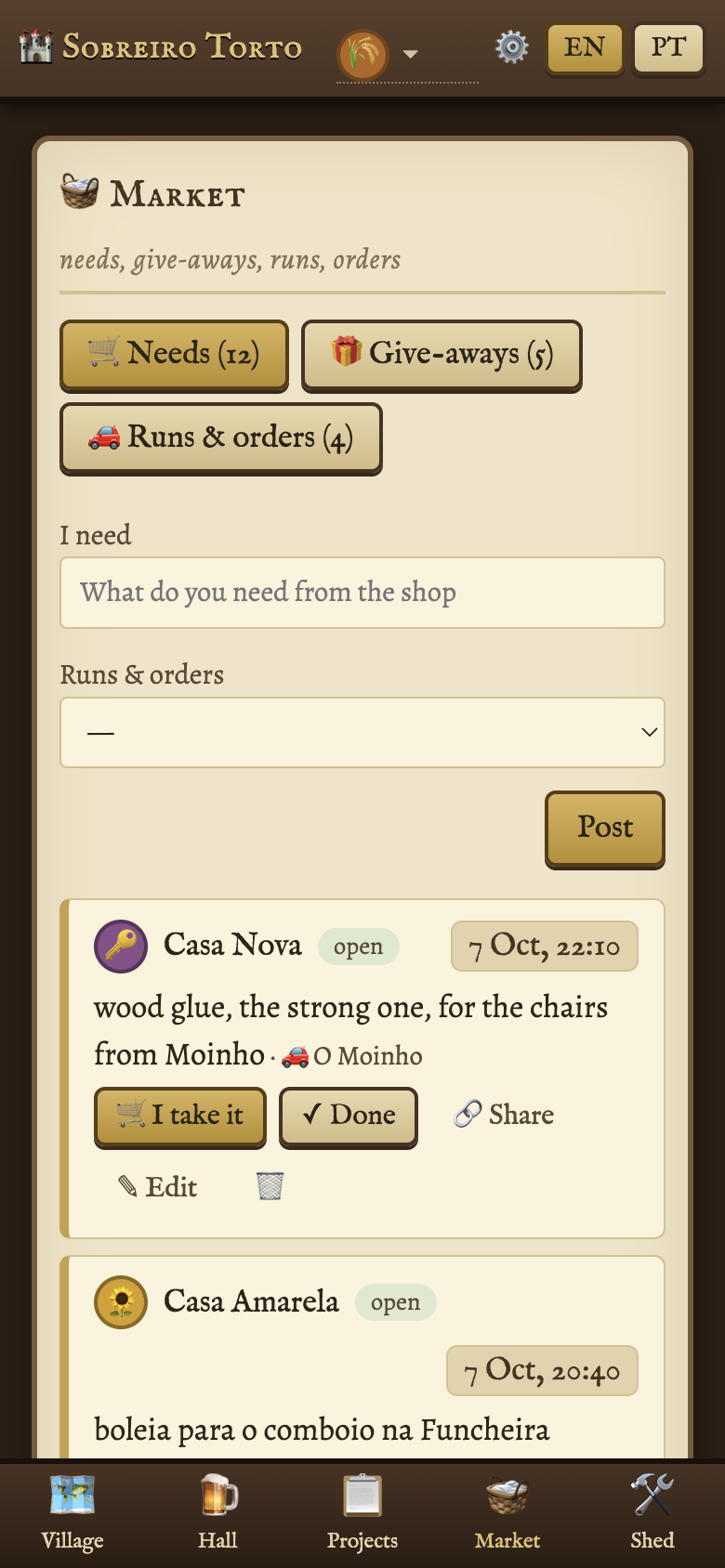
Market
"I go to the shop. Anyone need anything?" Shop trips with a deadline, requests a neighbour can take, and give-aways. Each has a status, not a place in a scroll.
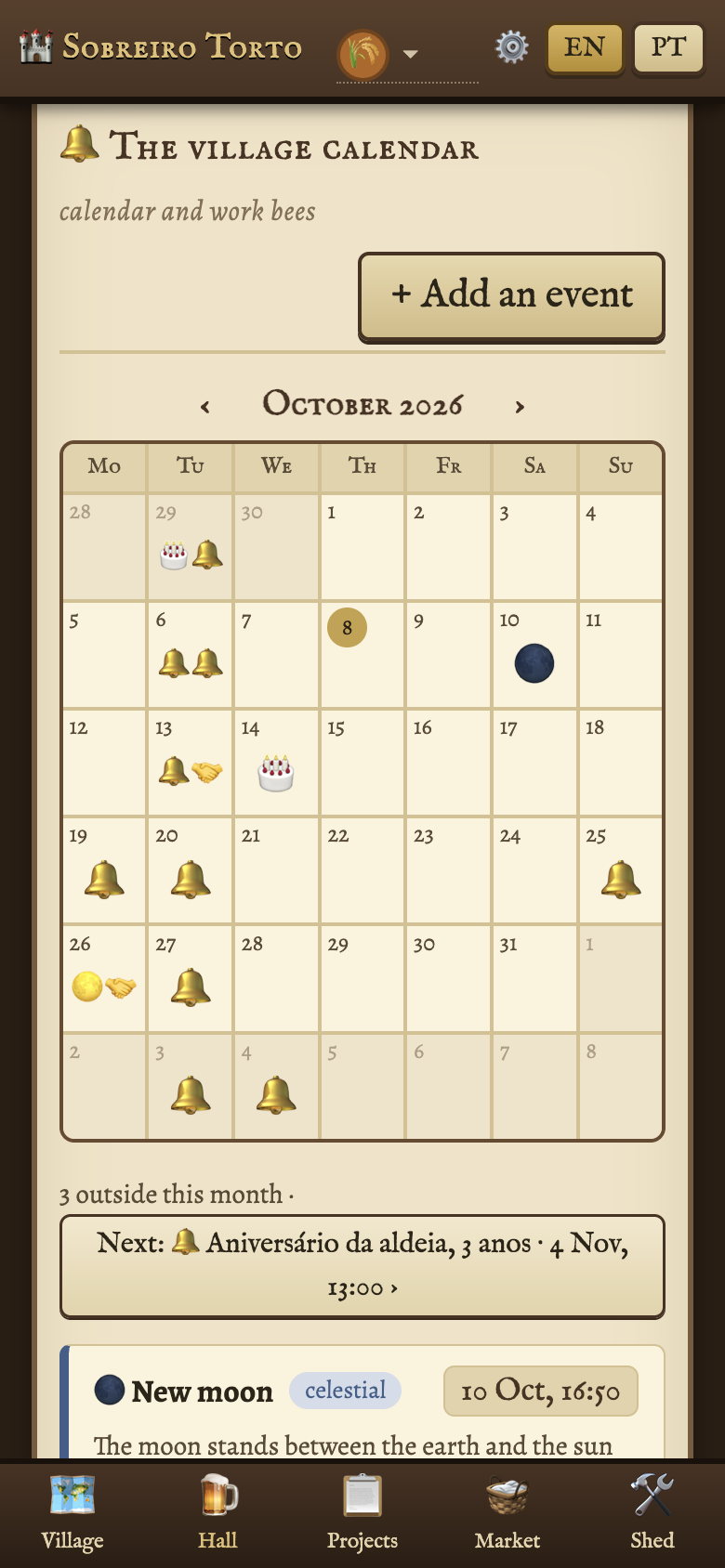
Tavern
Notices, the calendar with work parties and who comes, and the message board. One room, because a village has one hall.
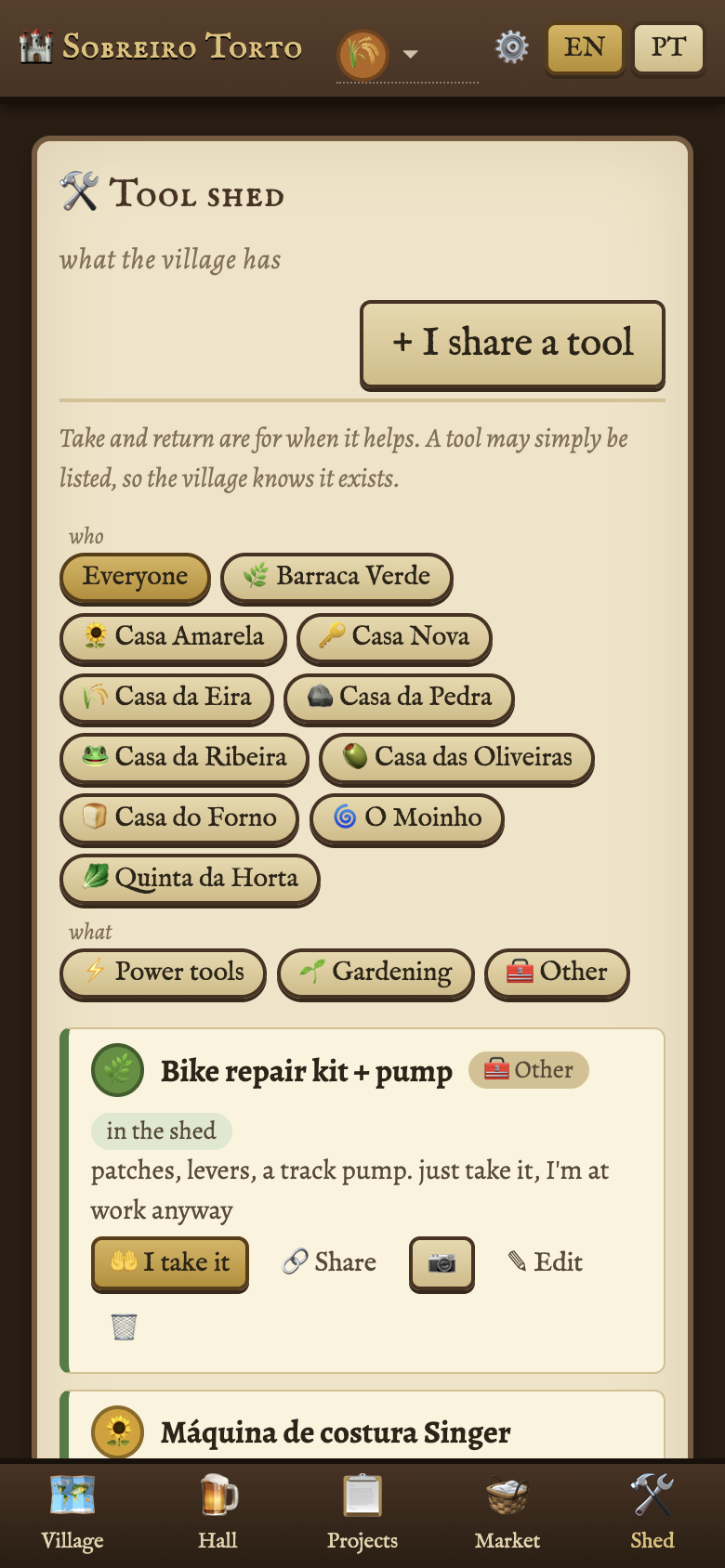
Tool shed
Who lends what, and who has it now. A reminder to give it back after a day, then less and less often. Not a debt list. Below: the tools the village still needs, and who wants one.
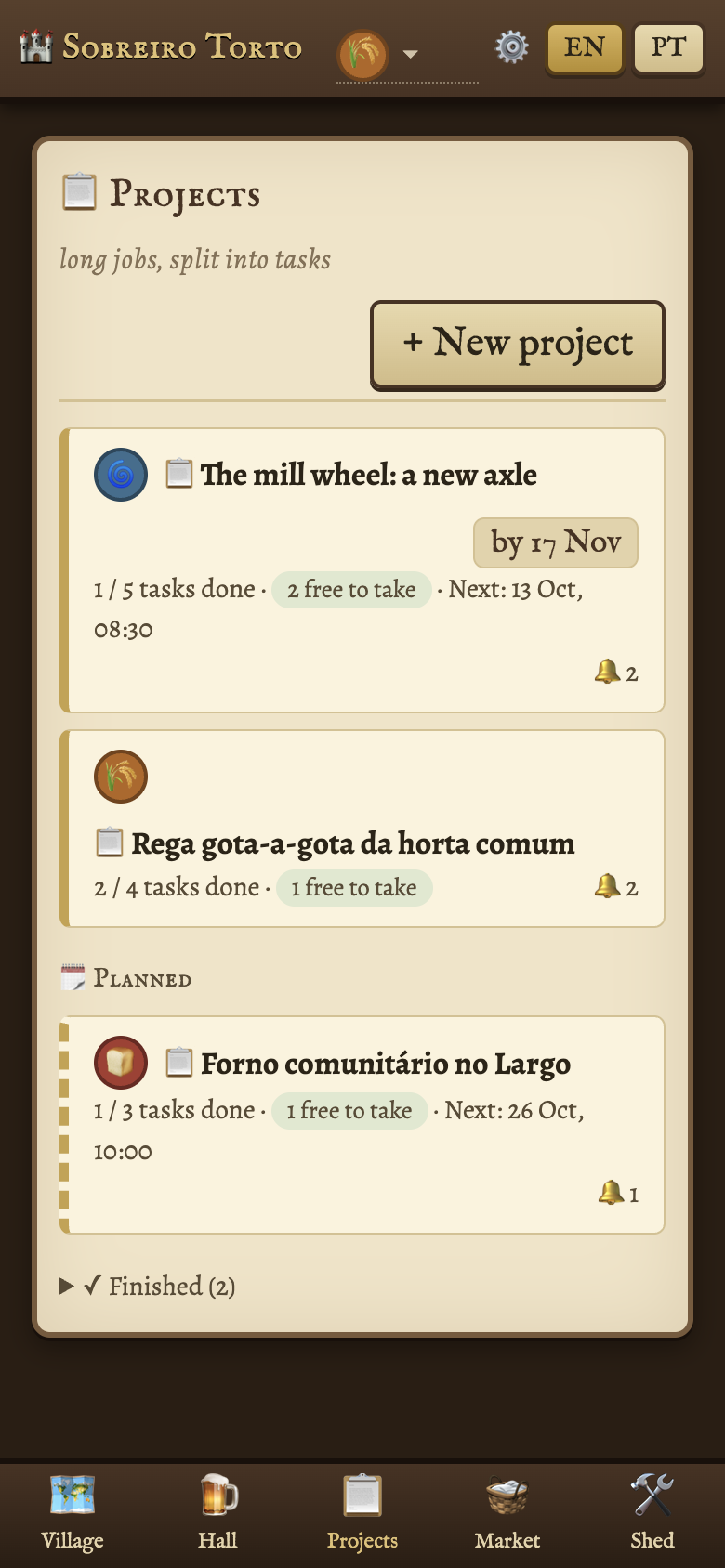
Projects
A big job, split into tasks that houses take. Planned, in progress, done, with photos.

Campground
A camper arrives, and a house collects the money and hands it on. No amounts, no number plates. Everyone hears who collects, so nobody collects twice. Off unless your village switches it on.
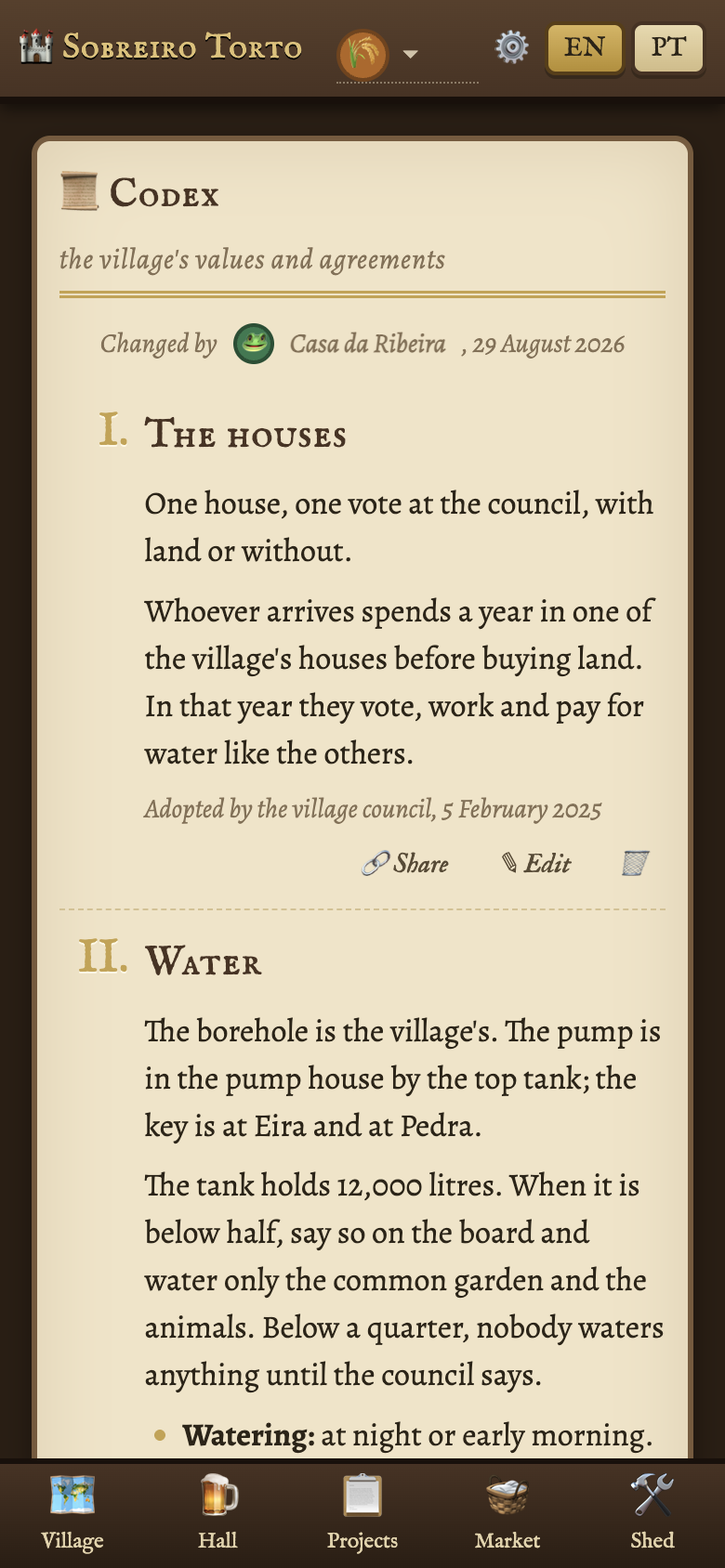
Codex
Your village's founding text, read before a house joins. Here it stays on top, in your languages, not in a drawer. Any house can change it, and the change shows its name.
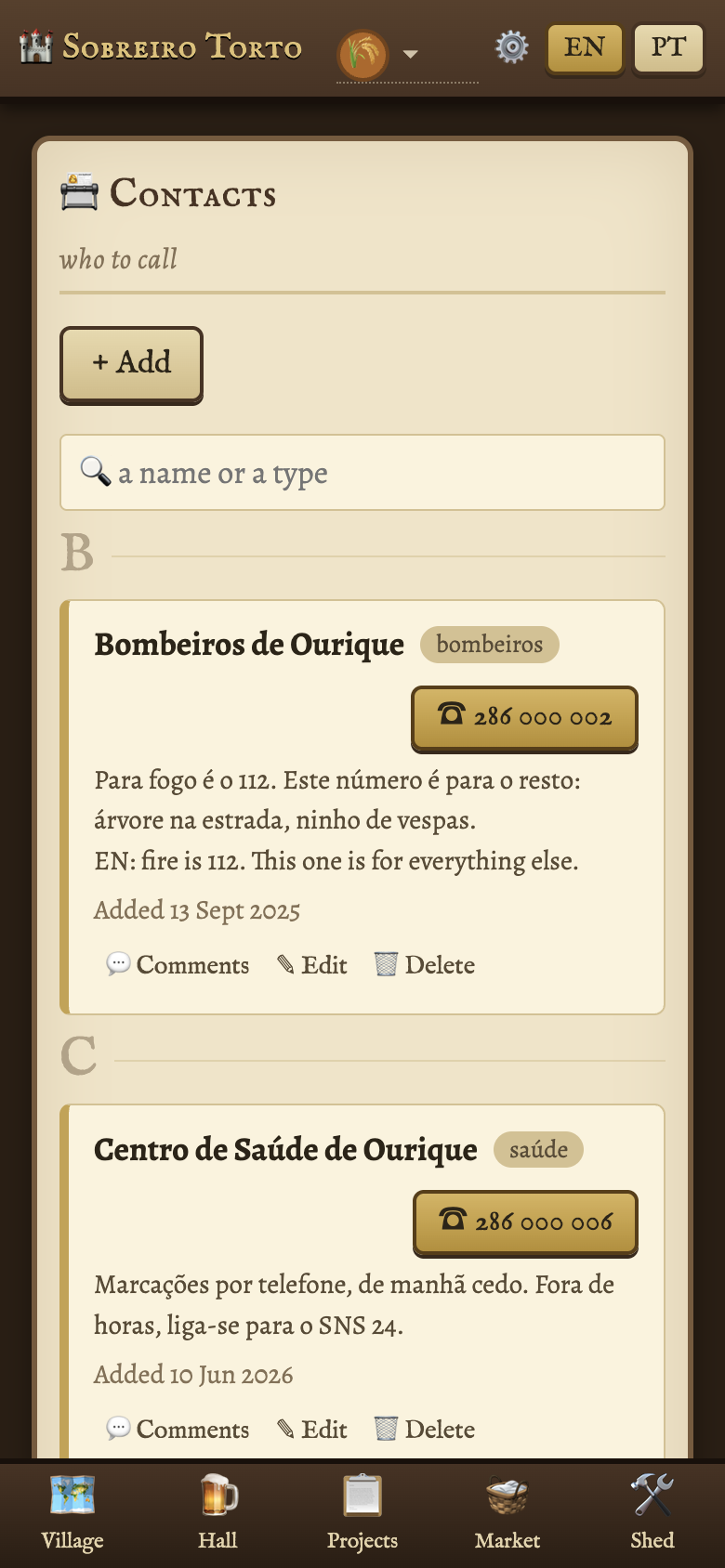
Contacts
"Who did we call about the well last time?" A name, a number, a note. Any house adds one or fixes one. It sends no notifications.
And a door for your AI assistant. A house makes a key, and its AI assistant acts for that house, like its phone. Claude Code works, and so does any assistant that speaks MCP, a common way for assistants to connect to apps. Say "put the work party on Saturday's calendar", and it is there. A house with no assistant sees no change.
Our promises, and what you can switch on
What the portal never does is the product. If you agree with this list, it was built for you.
Never
- Ads. Not now, not in a free version, not ever.
- Tracking. No analytics and no code from other companies, in the portal or on this page. This page has no scripts: check its source. The server logs visits to this page and the demo. Each line has the page, your browser type, the link you came from, and your internet address without its last part. We keep it 90 days, only to see if people find us.
- Public pages. Nothing in the portal is visible without a house login. Not on the web, not on another website.
- Selling. You pay for the hosting, on this page. Nothing is sold inside.
- Personal accounts. One login per house, shared by its phones. The portal cannot count people.
- Scores. No points, no rankings, no "most helpful house". Counted favours turn into debts.
- Growth tricks. No invite rewards, no streaks, no "your village is 60% set up".
- Names in notifications. Phones show "Somebody is away". Who, and until when, only after login.
Off unless your village turns it on
- A dues list. Who paid for the water this quarter.
- A duty roster with counts. Mowing, snow, the pump, and how many turns each house did.
- The campground. For a village with a place where campers stay and pay.
The steward, the house that runs the settings, switches each one. All start off, because the village that built the portal counts nothing. Your village decides, and it stays the same portal. The demo has all three on.
Your land, on the map
We draw your village from your country's public land map (the cadastre): bring the file, or we get it. Where height data exists, we work out the streams and ditches from it: the water your village argues about.
Slovenia today. For another country, ask us: if its land map is public, we usually can, and we tell you before you pay.
Your data
- Backups every night, kept on the same server.
- Download everything in one file, any day.
- Code anyone can read. Free to run yourself for one village of up to ten houses (Business Source License 1.1). Each version becomes open source (AGPL) four years after release.
- Leave any time, take everything. You get the full download, then we stop your village. We hold nothing back.
The price
Run it yourself
Free
- Up to ten houses, forever.
- The code and the instructions to run it on your own server.
- No support: the demo and the instructions are the help.
Run it yourself, licensed
€70 a year
- Or €7 a month. For more than ten houses, any number, on your own server.
- A licence key your server checks by itself. It never contacts us.
Hosted
€15 a month
- Per village, any number of houses.
- We run it for you, apart from other villages, at its own secure web address.
- Backups every night, updates, and a person who answers email within 48 hours.
Hosted, premium
€30 a month
- Everything in Hosted, on a server only for your village, in a country you choose.
- A second backup copy that you keep too.
- The server is yours: take it over any time, then it runs under the €70 licence.
Your map, drawn for you: €50, once. Your land from the public land map (Slovenia today) or a file you bring. Streams worked out from height data where it exists, your codex, a crest for each house.
No card needed to try it. Try the demo first.
The village that made it
I built Porta Pagi for my own hamlet, a few houses in a karst valley in Slovenia, where it runs today. Each room does one job our group chat did badly. The Watchtower is why it exists. It counts nothing, and I would choose that again.
My village is not on this page: crests on real land would show who lives where.
Questions
- Who is it for?
- Intentional communities, ecovillages, cohousing groups and hamlets: a few houses to a few dozen, sharing land, a road or a tool shed. Also a mountain hut group, a private road, an allotment garden. Not apartment buildings, which have no land to map. Not homeowners' associations that track rule breaking.
- Why not just the WhatsApp group?
- Keep it for talking. WhatsApp, Signal and Telegram are bad at finding things again: who is away, who has the ladder, who said yes to Saturday. The portal keeps each in its room, and notifies when needed.
- Does it ring on an iPhone?
- Yes, once it is on the home screen (Share, then Add to Home Screen, iOS 16.4 or newer). A banner on the iPhone shows how.
- Which languages?
- English, Slovenian and Portuguese. Each house picks from the village's languages. We add a new one when a village asks.
- Is it an app?
- It works like one: a home-screen icon and notifications. It installs from the browser, not an app store, on purpose: no store decides what your village may use.
- What happens if we stop paying?
- You get all your data, then we stop your village. We do not hold it.
- Where is our data, and under what terms?
- On our server, apart from other villages, readable only by your houses. The written terms (privacy, data agreement, what we keep and how long) are being finished with a lawyer. They will be here before the first hosted village pays. We say so rather than pretend.
- Who runs it?
- One person, who lives in the village that built it, and answers within 48 hours. More people help when needed.
- Can we run it ourselves and still ask for help?
- The instructions and the demo are the help. Email is for hosted villages. To host it for other villages, write to us.